
In a world of health coaches, influencers, and social-media “experts,” many people don’t realize that a Naturopathic Doctor (ND) in Ontario is a highly trained, regulated primary healthcare provider.
This confusion isn’t harmless. It leads to misunderstanding the role NDs play, underestimating their training, and overlooking a profession that helps address some of the most pressing gaps in our healthcare system.
Let’s talk about the training, the scope of practice, and the reality of what NDs do for healthcare in Ontario
Table of Contents
The Growing Burden on Ontario’s Healthcare System
Chronic Illness: What Often Gets Overlooked
What Is a Naturopathic Doctor?
Education: What Does it Take?
Scope of Practice: What Can an Ontario-Licensed ND Do?
How NDs Fit Into the Healthcare System
Comparison Chart - How Naturopathic Doctors Compare to Other Health Professionals in Ontario
The Growing Burden on Ontario’s Healthcare System
Ontario’s healthcare system is under immense strain. Long wait times, physician shortages, and an overreliance on emergency and acute care have left many people without adequate support for ongoing health concerns.
Primary care is overwhelmed. Appointments are short. Preventive care is often deprioritized—not because physicians don’t care, but because the system is designed to manage volume, not complexity.
This is where regulated complementary providers like Naturopathic Doctors help extend the reach of healthcare:
Increase access to primary care
Support prevention and chronic disease management
Reduce strain on an overburdened system
Provide patient-centred, comprehensive care
Support patients before conditions escalate
In a healthcare system under pressure, NDs are not an alternative—they are part of the solution.
2. Chronic Illness: What Often Gets Overlooked
Many of today’s most common health concerns don’t fit neatly into an acute-care model:
Fatigue and burnout
Digestive disorders
Hormonal imbalances
Metabolic dysfunction
Chronic pain and inflammation
Autoimmune and immune-mediated conditions
Stress-related illness
These conditions are real, impactful, and life-altering—yet they are often minimized, monitored without intervention, or managed symptom-by-symptom.
Naturopathic medicine is specifically trained to work in this grey zone: where symptoms are persistent, labs may be “normal,” and quality of life still suffers.
3. What is a Naturopathic Doctor?
A Naturopathic Doctor (ND) is a regulated primary healthcare practitioner trained to diagnose, treat, manage, and prevent disease using modern medical science alongside evidence-informed natural therapies.
In Ontario and several other jurisdictions, NDs are licensed healthcare providers with a protected title. This means not everyone can call themselves an ND—only those who have completed accredited doctoral-level medical training, passed board exams, and remain in good standing with the College of Naturopaths of Ontario (CONO).
Like other regulated healthcare providers, NDs must:
Carry professional malpractice insurance
Follow strict Standards of Practice
Participate in quality assurance and peer review programs
Complete mandatory continuing education credits to maintain licensure
In addition to the Naturopathy Act (2007), Naturopathic Doctors in Ontario are regulated under the Regulated Health Professions Act (RHPA)—the same legislative framework that governs Medical Doctors, Nurses, Dentists, and other regulated health professionals.
4. Education: What Does it Take?
Becoming an ND requires at least an undergraduate university degree, followed by a rigorous, four-year, full-time naturopathic medical doctorate from an accredited institution, such as the Canadian College of Naturopathic Medicine (CCNM).
Core Medical Sciences
Naturopathic medical education mirrors conventional medical training in foundational sciences, including:
Anatomy
Physiology
Biochemistry
Pathology
Microbiology
Health psychology
Cadaveric dissection
Physical examination & clinical diagnosis
Evidence-based medicine & research methods
Laboratory medicine & bloodwork interpretation
Medical imaging interpretation (X-ray, MRI, ultrasound)
Pharmacology (including drug interactions and prescribing principles)
Naturopathic Therapeutics
In addition, ND training includes extensive education in therapies not emphasized in conventional medical training:
Clinical nutrition
The typical MD receives approximately 20 hours of nutrition education during medical school. In contrast, NDs complete over 200 hours of dedicated nutrition training, covering clinical nutrition, therapeutic diets, evidence-informed supplementation, and nutraceutical dosing.
Botanical medicine
Lifestyle & behavioural medicine
Physical medicine
Traditional Chinese medicine
Acupuncture
Hydrotherapy
Homeopathy
Before graduation, ND students complete over 3,000 hours of classroom education and more than 1,200 hours of supervised clinical training, followed by national board examinations.
5. Scope of Practice: What Can an Ontario-Licensed ND Do?
Within their regulated scope, Ontario-licensed NDs can:
Take comprehensive medical histories
Perform physical examinations
Order and interpret laboratory testing
Provide medical diagnoses
Develop individualized treatment plans
Prescribe natural health products and therapeutics
Provide lifestyle, nutrition, and preventive care
Collaborate with and refer to other healthcare professionals
NDs are trained to recognize red flags, work within scope, and collaborate with conventional medicine when needed. They do not replace MDs—but they complement the healthcare system, particularly in prevention, chronic disease management, and patient education.
6. How NDs Fit Into the Healthcare System
Naturopathic Doctors are not an alternative to healthcare—they are part of it.
Amid physician shortages, long wait times, and increasing chronic disease, NDs help fill critical gaps in care by expanding access, easing pressure on the healthcare system, and delivering patient-centered, preventative support.
-
Ontario’s healthcare system is designed primarily for acute care—diagnosis, crisis management, and short appointments. This model works well for emergencies and clearly defined disease states, but it struggles with prevention, complexity, and long-term support.
NDs spend time where the system often can’t.
-
Many of today’s most common conditions—diabetes, cardiovascular disease, autoimmune illness, mental health concerns—develop gradually over years.
NDs focus on:
Early intervention
Risk factor identification
Lifestyle, nutrition, and metabolic support
Preventive screening and monitoring
This upstream approach helps reduce progression, complications, and reliance on emergency or specialist care later on.
-
When symptoms persist despite “normal” test results, patients are often told to monitor, wait, or manage discomfort.
NDs are trained to ask:
Why is this happening?
What systems are involved?
What can be modified to restore function?
Rather than treating symptoms in isolation, NDs assess the interconnected drivers of health—nutrition, hormones, digestion, stress physiology, sleep, inflammation, and environment—to develop comprehensive treatment plans.
-
Chronic illness rarely fits into a 7–10 minute appointment.
NDs routinely support patients with:
Autoimmune and inflammatory conditions
Hormonal and metabolic disorders
Digestive and gut-immune issues
Chronic pain and fatigue
Stress-related and nervous system dysregulation
This care is ongoing, individualized, and adaptive—designed to evolve with the patient over time.
-
NDs do not replace family doctors or specialists.
They:
Interpret lab results in clinical context
Help patients understand diagnoses and treatment plans
Support adherence and lifestyle implementation
Monitor progress and adjust care plans
Refer back to MDs or specialists when indicated
For many patients, an ND becomes the provider who helps translate medical information into day-to-day action.
-
Naturopathic medicine works best when integrated.
NDs collaborate with:
Family physicians
Specialists
Dietitians
Physiotherapists
Mental health professionals
This team-based approach improves continuity of care and reduces fragmentation—one of the biggest challenges patients face navigating the system.
7. How Naturopathic Doctors Compare to Other Health Professionals in Ontario
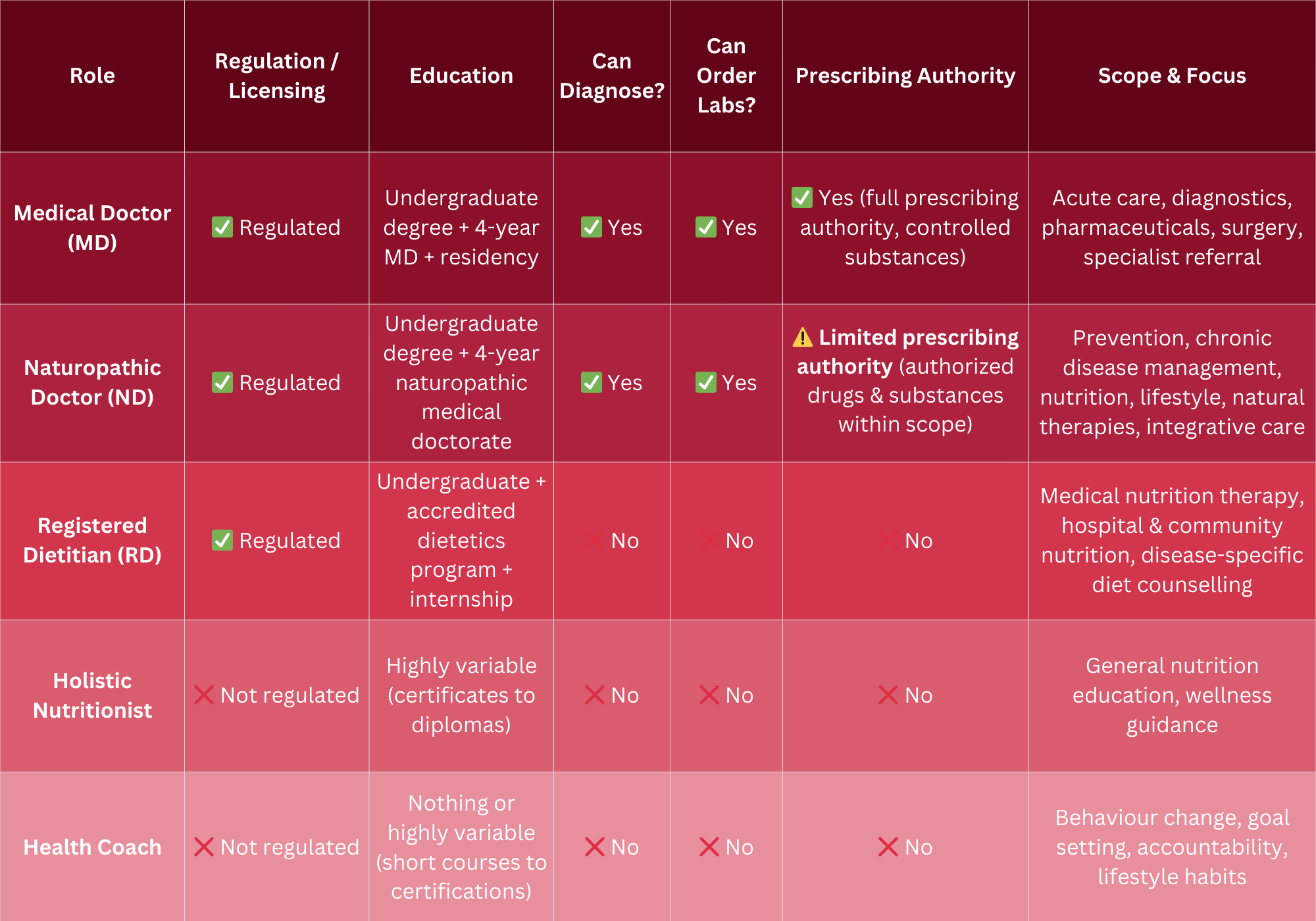
Quick Comparison Chart
If this resonates with you, book a free consult call with me and learn about how naturopathic medicine would benefit you!